
In-depth Analysis: The Differences Between Detachable (Quick-Assemble) Container Houses and Flat-Pack Container Houses
Integrated buildings have become an indispensable construction solution for construction sites, field operations, and even emergency rescue. Among them, Detachable (Quick-Assemble) container houses and flat-pack container houses are the two mainstream products on the market. Although they both belong to modular buildings and are often confused, they differ essentially in structural design, installation method, performance characteristics, and application scenarios. This article breaks down their differences in detail.
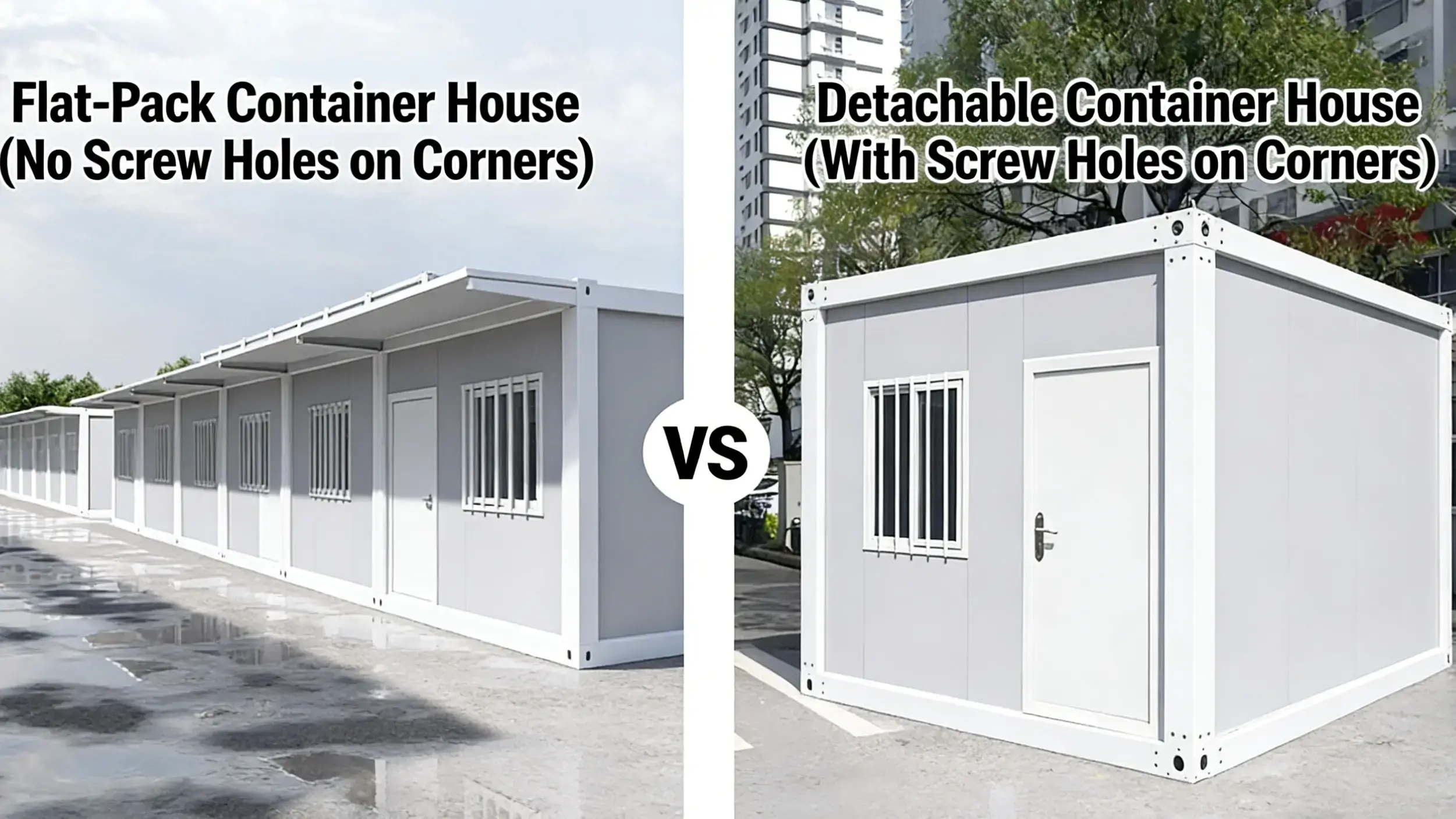
1. Core Structural Difference: Bolted Connection vs. Welded Structure
The most fundamental difference lies in the frame connection method, which determines structural strength, installation efficiency, and service life.
Detachable (Quick-Assemble) Container House
An improved product based on prefabricated temporary houses.
①Columns, top beams, and bottom beams are connected mainly by fastening bolts.
②Factory-prefabricated components are assembled on-site like building blocks to form a complete rectangular frame, followed by wall and roof panel installation.
③Requires dozens to hundreds of on-site bolts (e.g., 64 bolts for a standard 3m×6m unit).
Flat-Pack Container House
An upgraded modular building derived from export-style containers, with a steel frame and lightweight wall panel system.
①Columns, top frames, and bottom frames are firmly connected by welding.
②A rigid frame unit is formed in the factory; on-site assembly requires no complex welding.
2. Installation Efficiency vs. Transportation Cost
Installation Efficiency
- Detachable (Quick-Assemble): Faster in theory; only wrenches are needed, no welding wait time.
- Flat-pack: More comprehensively efficient; a skilled team of 4 workers can complete one unit in about 3 hours.
Transportation Efficiency
- Flat-packis designed for compact “flat-pack” shipping.A standard 40-foot container can hold components for 6 flat-pack units, greatly reducing long-distance and ocean freight costs.
- Detachable (Quick-Assemble)units can be shipped disassembled but have lower standardization and stacking efficiency.
3. Physical Performance: Waterproofing & Structural Strength
Waterproofing
- Detachable (Quick-Assemble): Historically weak at bolted joints; modern versions use improved seals and gaskets for better performance.
- Flat-pack: Factory-optimized waterproofing with built-in top drainage channelsand hidden downpipes in columns, eliminating most leakage risks.
Sturdiness
- Flat-packhas better integrity and stability due to welded frames, with stronger wind and seismic resistance for harsh environments.
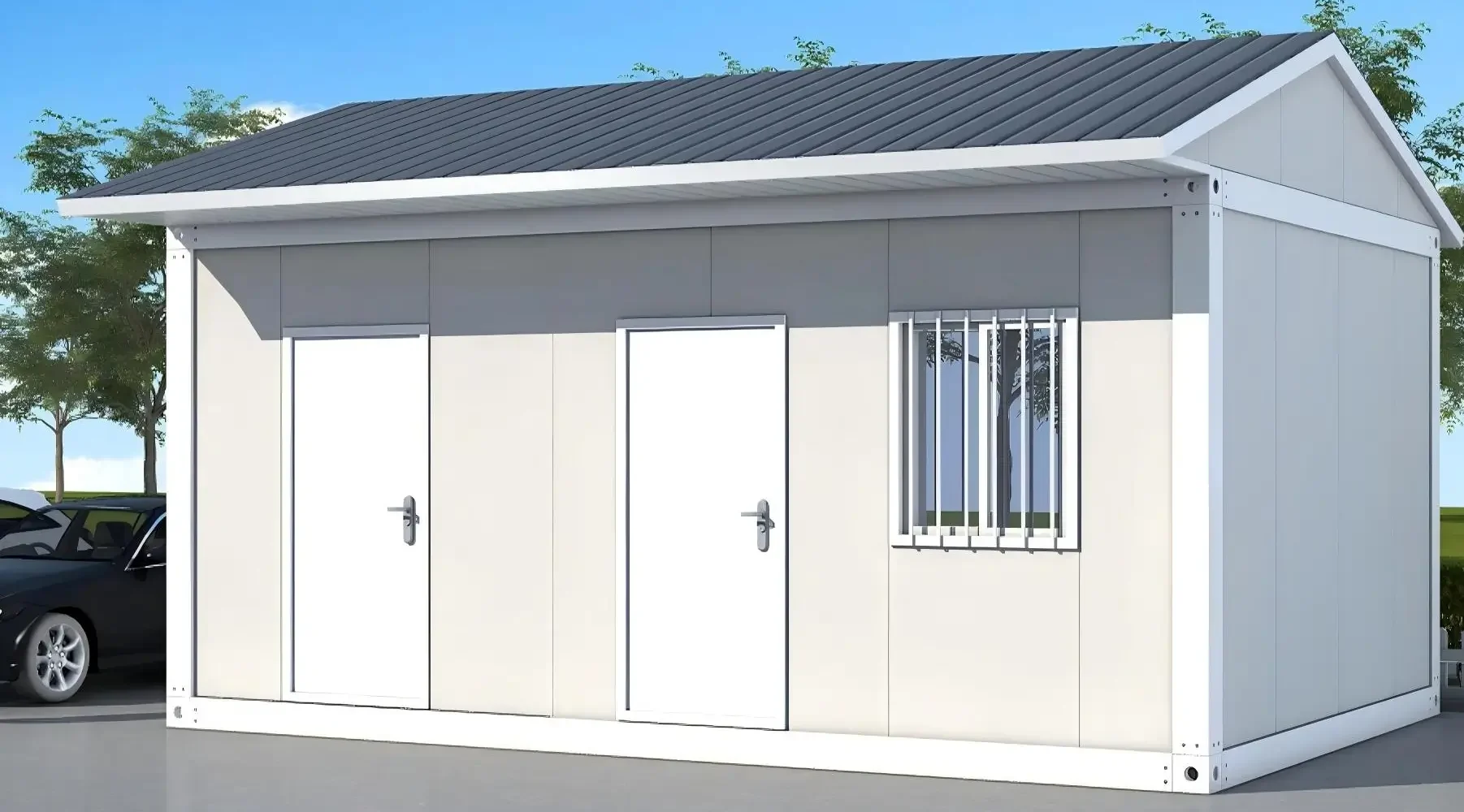
4. Application Scenarios & Market Positioning
Detachable (Quick-Assemble) Container House
①Lower cost, easy to install, low technical requirements for workers.
②Mainly used for general construction sites (offices, dormitories).
Flat-Pack Container House
Positioned as high-end:
①Attractive appearance, excellent waterproofing, easy relocation, low wear during repeated assembly.
②Widely used in:
High-end construction sites
International aid & overseas projects
Commercial facilities: exhibition halls, sales centers, cafes
Tourism: homestays, hotels, scenic resorts
Field camps: exploration, mining
| Comparison Item | Detachable (Quick-Assemble) Container House | Flat-Pack Container House |
| Connection Method | Bolted / Fastening screws | Welded |
| Waterproof & Drainage | No systematic drainage; leakage risk | Built-in drainage channels + column downpipes |
| Transportation | Loose parts, on-site assembly | Flat-packed for high-efficiency ocean shipping |
| Installation Speed | Fast single-unit assembly | 4 workers / 3 hours per unit |
| Appearance | Traditional temporary building style | Stylish, modern, high-end look |
| Main Applications | General construction sites | Overseas aid, commercial use, high-end camps |

Conclusion
Both are upgraded alternatives to traditional prefabricated houses, but follow different technical paths:
- Detachable (Quick-Assemble): Focuses on fast on-site assembly and cost control.
- Flat-pack: Emphasizes structural strength, waterproofing, and transport economy, representing a higher-end, eco-friendly trendin temporary construction.
Choose based on project location, service life, aesthetic requirements, and budget.