
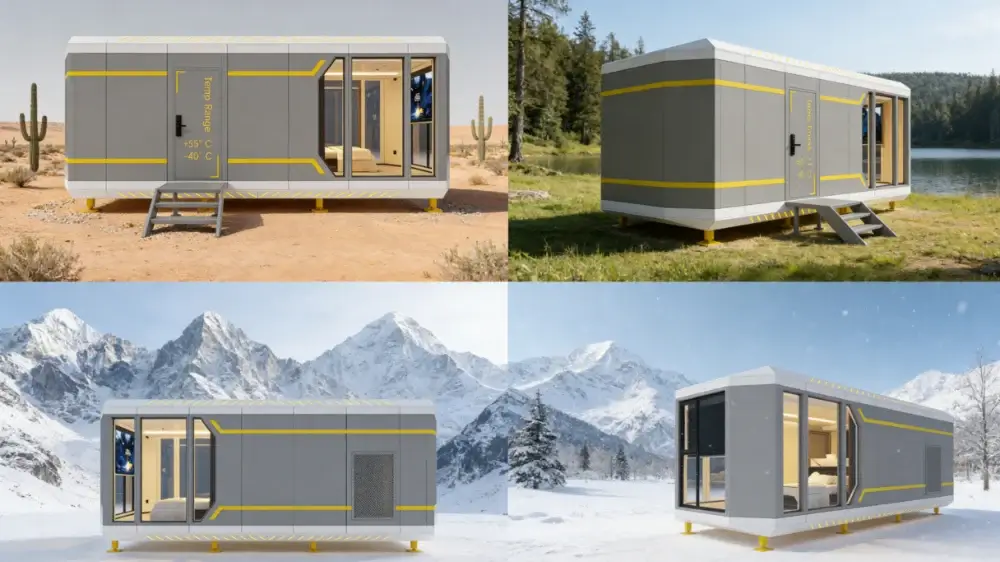
Modular Integrated Buildings: The “Building Blocks” Reshaping the Future of Construction
Amid rapid urbanization, intensifying climate challenges, and growing demand for resource circularity, the construction industry is undergoing a profound industrial transformation. Modular integrated buildings—a new form of construction centered on factory production and on-site rapid assembly—are quietly redefining our traditional understanding of “building a house” with their efficiency, sustainability, and flexibility.
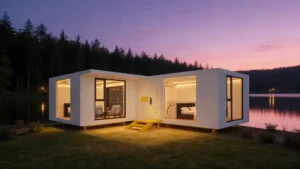
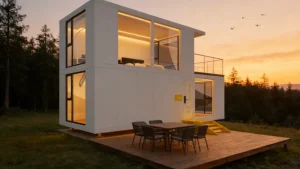
If traditional construction is likened to “painting,” modular construction is more like “assembling building blocks.” A building is divided into standard spatial units—modules—fully prefabricated in factories. These modules complete all processes on production lines, from frame welding and wall infill to interior finishing and even pre-installation of water and electrical pipelines, before being transported to the project site for hoisting and connection.
The disruptive nature of this model lies in shifting most open-air, high-risk wet work to a controlled indoor environment. Enabled by full-lifecycle management via BIM (Building Information Modeling), from digital modeling at the design stage to automated welding and CNC cutting at production, it achieves seamless plan execution and high-precision manufacturing. This not only greatly improves construction accuracy but also shortens traditional construction timelines from years to weeks or months.
- Beyond “Temporary Shelters”: From Emergency Resettlement to Future Communities
For too long, modular buildings have been perceived merely as construction site sheds or temporary disaster-relief shelters. With technological advancements, however, today’s modular integrated buildings boast powerful multi-scenario adaptability.
- Guardian of Emergency and Livelihood Security
In critical disaster-response moments, time is life. The rapid-deployment nature of modular buildings makes them ideal for emergency resettlement, providing safe, warm temporary housing for disaster victims in record time. For remote mountainous areas, ecologically sensitive zones, or complex waterfront terrains, their lightweight design drastically cuts transport and installation costs, solving the difficulties of traditional building material delivery and construction.
- Aesthetic Carrier for Culture, Tourism, and Study Tours
In cultural-tourism camps or study-tour bases, modular buildings break free from generic “boxy” designs. Through flexible combinations based on standardized design, they can transform into nature-integrated luxury wilderness hotels or stylish, design-forward study spaces. Excellent thermal insulation, wind resistance, and seismic performance ensure comfortable living experiences across different climate zones. Innovative Driver of Urban Renewal Modular buildings offer new solutions to the reuse of dense urban spaces. For example, as pilot youth apartments, they quickly create fully equipped living spaces on idle land, exploring new models for high-density populated areas. In clustered layouts, these modules can even form “vertical communities” or “future communities,” serving as pilot examples of sustainable urban development.
Plug and Play: A Green Revolution Driven by Technical Core
The appeal of modular buildings extends far beyond construction speed to their inherent green credentials.
Structurally, steel or aluminum alloy frames deliver exceptional seismic and wind resistance. Composite sandwich panels in walls provide superior thermal insulation, reducing energy consumption over the building’s full lifecycle.
Functionally, modular electrical and plumbing interfaces support true “plug and play.” With interfaces precisely pre-installed in factories, on-site work only requires simple pipeline connections to instantly activate the entire building, eliminating the dust and noise of on-site grooving and wiring.
Environmentally and circularly, this construction shifts from the linear “build–demolish” model to a circular “manufacture–use–reuse” model. When a building needs relocation or functional change, module units can be easily disassembled, moved, and reassembled at a new site, greatly improving resource utilization and reducing construction waste.
Conclusion
From high-precision automated factory production lines to rapid emergency resettlement sites and urban future communities, modular integrated buildings are crossing the line between “temporary” and “permanent.” They are both an inevitable outcome of construction industrialization and a profound response to resource constraints and environmental challenges.
They integrate into nature with “light intervention,” serve society with “high efficiency,” and honor the future with “circularity.” As technologies advance and public perception evolves, this flexible, efficient, and green building form—like building blocks—will surely occupy a more important place in future living environments, driving the construction industry toward deeper, more sustainable evolution.