
Customization of Containerized Modular Dormitory Camps
Containerized modular dormitories are suitable for remote and harsh environments such as oilfields and mining areas. Their core advantages lie in high customization, quick installation, low maintenance costs, and reusability, achieving “design on demand, convenient deployment, and long-term economy.”
Key Points of Customized Design (Precise Adaptation to Scenario Requirements)
- Unit Type and Layout Customization
- Select based on personnel scale and shift system: single rooms, double rooms, quadruple rooms, six-person rooms, etc.
- Flexible configuration of functional zones: bedrooms (optional bunk beds), private/public toilets, shower rooms, simple kitchens, leisure/storage areas.
- Examples: Oilfield workers’ dormitories: large dormitory-style rooms with shared beds + public showers + simple canteens.
Mining area management dormitories: single/double rooms + private bathrooms + small office areas.
- Facility and Environmental Adaptation
- Water and electricity systems: Equipped with independent distribution boxes, voltage stabilizers, and large-capacity water storage tanks (to cope with voltage fluctuations and inconvenient water supply).
- Thermal insulation: For frigid regions (minimum temperature -45℃), rock wool core material with a thickness of 150–200mm is recommended, along with upgraded door and window sealing (double-layer Low-E glass), dust-proof air conditioners/electric heaters/heat blowers.
- Safety configurations: Emergency lighting, smoke detectors/fire-fighting equipment, monitoring systems, and escape routes.
- Other upgrades: Dustproof/anticorrosive coatings, non-slip/insulated floors, and explosion-proof lamps (for oil and gas environments).
- Overall Scheme Planning
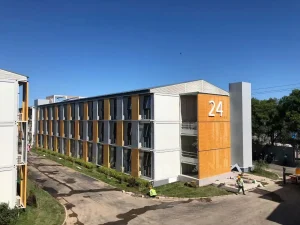
- Supports horizontal/vertical splicing (up to 3 floors) to form a complete camp (dormitories + offices + canteens + laundry rooms, etc.).
- Factory prefabricated design considering site conditions, foundation, wind load, and transportation requirements.
Key Points of Practical Installation (Simple and Efficient)
- Required Manpower and Tools
3–5 general workers + small cranes/forklifts + conventional tools such as wrenches, screwdrivers, and electric drills.
- Standardized Process
- Foundation preparation (leveling + simple foundation).
- Hoisting and positioning of units.
- Bolt/buckle splicing and fixation (precise positioning with small errors).
- Quick connection of pipelines (standardized reserved interfaces for water and electricity).
- Construction Period
- A single building or small camp can usually be spliced within 3–5 days.
- Large-scale camps can be completed in 1–2 months, significantly saving manpower and time.
Key Points of Maintenance and Management (Low Cost and Easy Operation)
- Daily/Regular Inspections (Can be Part-Time by On-Site Personnel)
① Steel structure anti-corrosion: Derust and touch up paint every 6 months.
② Door and window sealing: Check for aging rubber strips and smooth opening/closing; replace in a timely manner.
③ Water and electricity pipelines: Check for water leakage, looseness, or damage; repair promptly. - Low Maintenance Costs
① No full-time team is required.
② Standardized accessories are easy to purchase. - Dismantling and Transportation
① Dismantling and classified packaging can be completed within 1–2 days.
② Transported by ordinary trucks → Cleaned and simply maintained at the new site for reuse.
③ Achieves “one-time investment, multiple turnovers” with a service life of over 15–20 years.



A really good blog and me back again.
Very good i like it