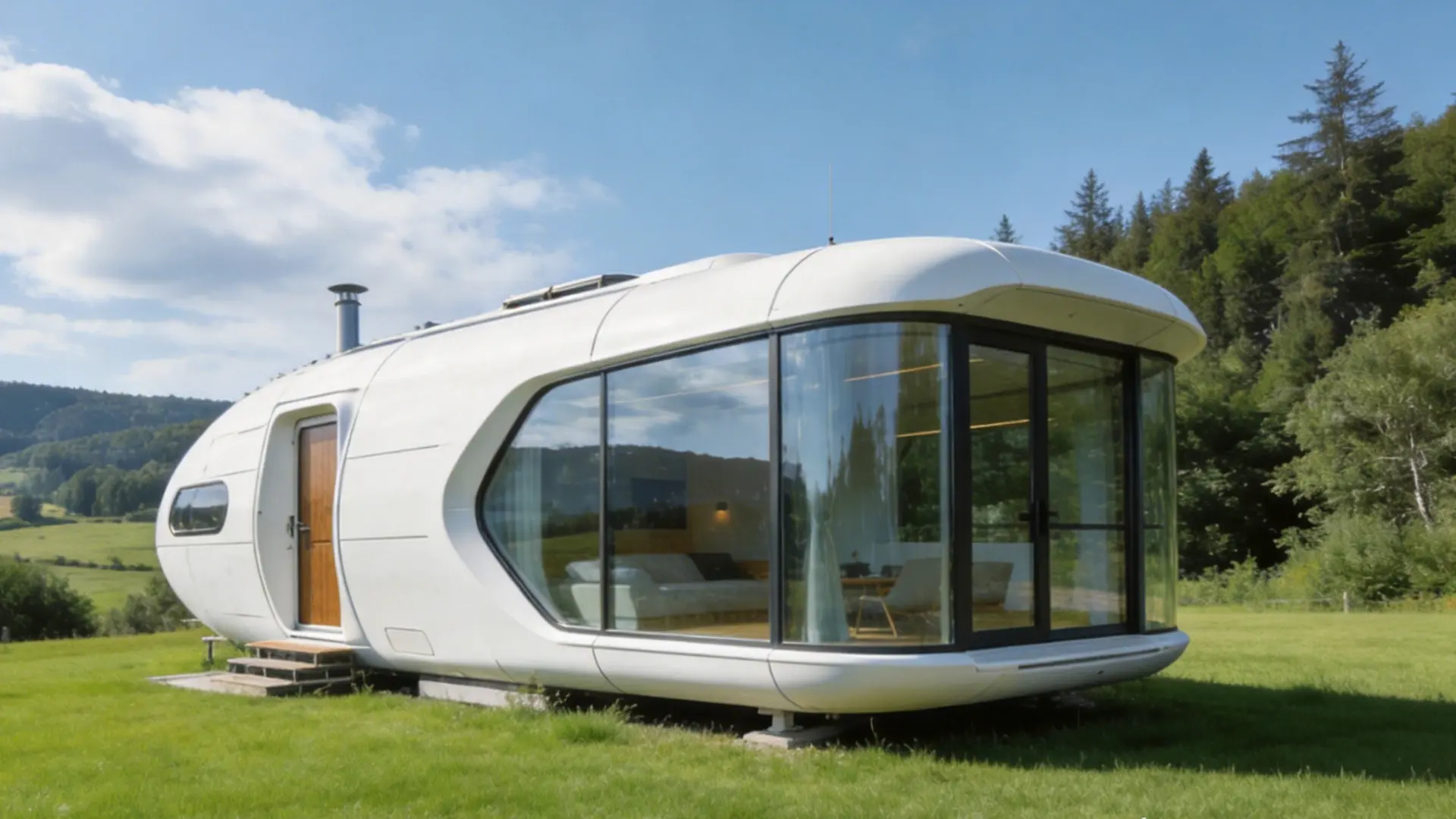
The Application of Space Capsule Prefab Houses in the European and American Airbnb Market: Market Prospects, Success Stories, and Operational Guide
In recent years, a new type of accommodation combining futuristic design with immersive experiences—the space capsule prefab house—has been quietly gaining traction in the European and American Airbnb market. From a “UFO homestay” in rural Wales to a “Space Shuttle cabin” in Washington State, these futuristic lodging units are becoming the new darling of the short-term rental market, thanks to their unique visual impact and social media shareability.
This article systematically outlines the application landscape of space capsule houses in the European and American Airbnb market, covering market background, typical models, successful case studies, regulatory challenges, and investment advice. It also introduces how emerging brands like JS-HOUSES are providing solutions in this field.
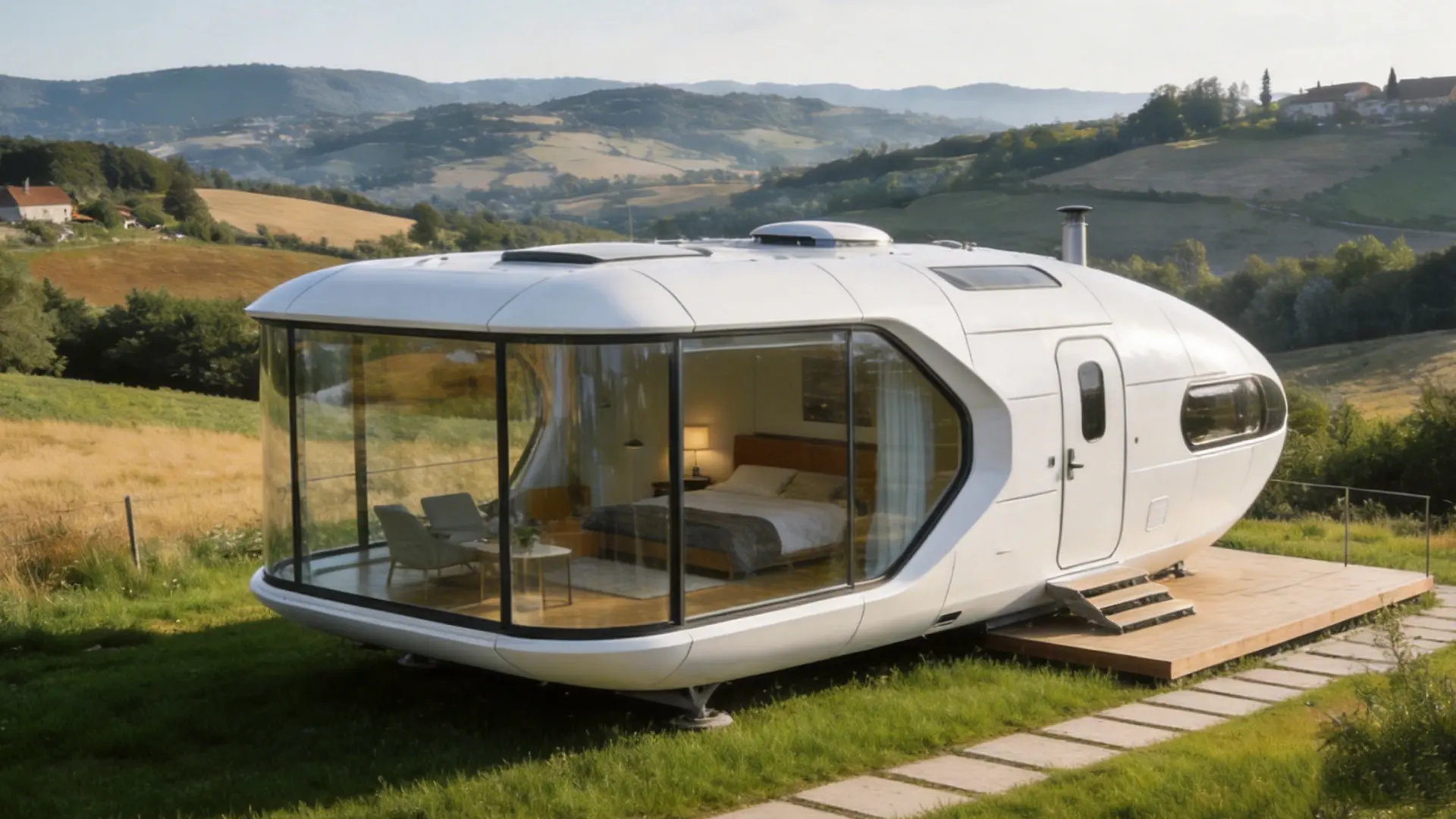
1. Market Background: Why Are Space-Themed Accommodations So Popular in Europe and America?
The rise of space-themed accommodations is the result of several converging social trends.
1. Experience-Driven Consumption Upgrades
For Millennial and Gen Z travelers seeking novel experiences, accommodation itself has become a core part of the travel experience, not just a place to sleep. With their futuristic exteriors, star-gazing skylights, and smart control systems, space capsule houses perfectly meet this demographic’s demands for “Instagrammable” moments and uniqueness.
2. An Extension of the Tiny Home Boom
According to market research, the global tiny home market is expanding at a compound annual growth rate of approximately 6.9%, and is expected to exceed $30 billion by 2033. Within this trend, space capsules—as a more design-driven branch of tiny homes—have naturally attracted the attention of Airbnb hosts and investors. Their compact footprint (typically 15-30 square meters), lower operating costs, and mobility make them ideal vehicles for vacation rentals.
3. The Maturation of Modular Construction
Advances in prefabricated construction technology have made the international transport and rapid deployment of space capsules feasible. Brands like JS-HOUSES, through innovative modular disassembly systems and international compliance certifications, are effectively reducing cross-border logistics costs and meeting European and American market access requirements, laying the groundwork for large-scale application of space capsules in these markets.
4. The Amplifier Effect of Social Media
Space capsule houses are naturally “viral.” On platforms like TikTok and Instagram, hashtags such as #UniqueStay and #UFOAirbnb continue to trend, and user-generated content provides these listings with nearly zero-cost, highly targeted exposure.
2. Typical Models of Space Capsule Airbnbs in Europe and America
Space-themed Airbnbs in Europe and America currently take several main forms:
2.1 Repurposed Structure Model
One of the most representative examples comes from Pembrokeshire, Wales. Homeowner Martin Johnson purchased a discarded generator cover from the 2012 London Olympics on eBay for £3,000. After six months of renovation, he transformed it into an Airbnb called “Spodnic UFO.”
Key features of this listing:
Highly futuristic exterior with LED lighting and a fog machine to simulate a “UFO landing” at night
Immersive-themed interior using electronic components and control panels to mimic a spaceship cockpit
Enhanced guest experience including a private hot tub, separate garden, and bathroom
Global clientele having hosted sci-fi fans from China, the US, and beyond
The advantage of this model is the relatively controllable renovation cost (original budget was only £7,500), along with an inherent “recycling” narrative that easily attracts media attention.
2.2 Custom Prefabricated Capsule Model
Companies like JS-HOUSES specialize in producing rocket-shaped and futuristic-style prefabricated capsule houses. Their standard space capsule (approximately 28 square meters) can be assembled within days, as flexibly as building with Lego bricks. These products typically offer a basic one-bedroom, one-bathroom layout, as well as more spacious two-story versions.
In the US market, similar products are rapidly gaining traction. The “Space Shuttle” listing in Brush Prairie, Washington, is a 700-square-foot (about 65 square meters) space shuttle-shaped house that can accommodate up to 8 guests and sits on 5 acres of gardens.
2.3 Integration into High-End Campgrounds/Resorts
Using space capsules as an upgraded form of glamping is a mature business model in European and American markets. This application is typically led by professional operators who deploy clusters of space capsules in scenic remote areas (such as near national parks or dark sky reserves) to form themed accommodation clusters.
A notable case is the Apollo 11-themed space capsule in Pukaki, New Zealand, located within the Mackenzie International Dark Sky Reserve, offering guests exceptional stargazing conditions.
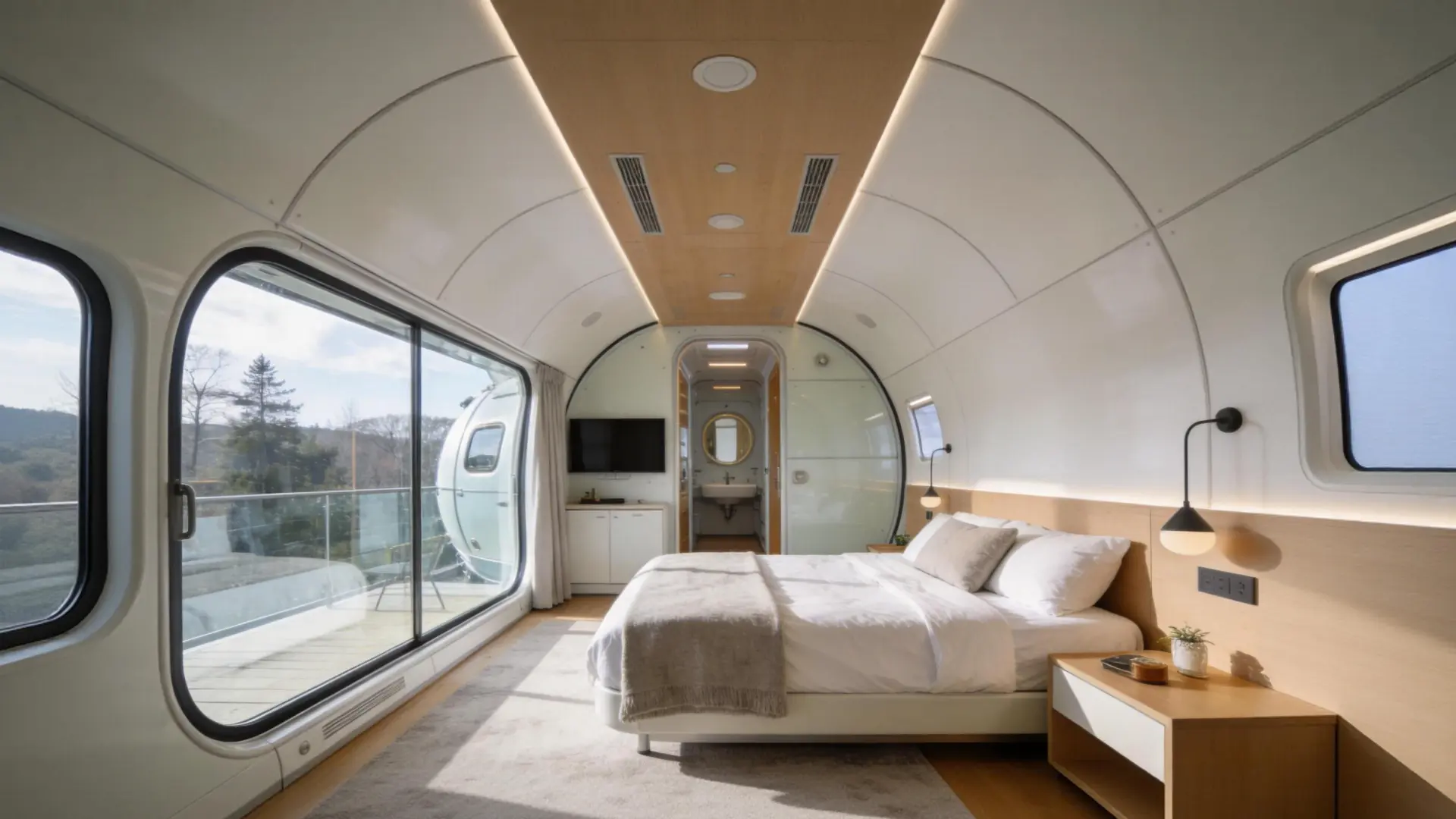
3. In-Depth Analysis of Successful Case Studies
The following are several successful examples from European and American markets worth learning from:
| Case Name | Location | Core Features | Renovation Cost/Price | Operational Highlight |
| Spodnic UFO | Pembrokeshire, UK | Repurposed Olympic structure, LED lighting, hot tub | £3k (shell) + £4.5k (renovation) | Mystery marketing, guests book “blind” surprise experience |
| Space Shuttle | Washington State, USA | 700 sq ft, sleeps 8, 5-acre garden | Custom-built | Targets families/groups, spacious layout |
| Futuro House | Joshua Tree, California, USA | 1960s retro flying saucer shape, desert landscape | ~€400/night | Integrated into national park tourism, high ADR |
| Apollo 11 Capsule | Pukaki, New Zealand | Dark sky reserve, stargazing, private bathroom | Custom-built | Extreme location + strong theme (50th anniversary of moon landing) |
What these cases share: unique natural resources (coastline, desert, dark skies), strong and consistent themes inside and out, and ancillary experiences beyond just sleeping (hot tubs, stargazing equipment, etc.).
4. Regulatory and Compliance Challenges: The Specifics of European and American Markets
For investors planning to operate space capsules on Airbnb, compliance is the first major hurdle. European and American markets have complex regulatory systems governing planning permission, building codes, and short-term rental licensing.
4.1 United Kingdom: Strict “Holiday Use” vs. “Permanent Residence”
UK regulations for mobile homes clearly distinguish between holiday use and year-round residence.
Planning permission restrictions: Many plots of land that allow mobile homes have planning permission explicitly limited to “holiday use only,” requiring the occupant to vacate for a period each year (e.g., one month out of eleven); otherwise, it constitutes a violation.
Licenses and permits: Under the Caravan Sites and Control of Development Act 1960, operating a site with multiple mobile homes requires a site license from the local authority.
New regulations in Wales: Wales will soon implement stricter visitor accommodation registration and licensing rules. From autumn 2026, all short-term rentals (up to 31 consecutive nights) must register with the Welsh Revenue Authority; a future licensing system will require listings to meet health, safety, and fire standards for tourist accommodation.
4.2 United States: Significant State-by-State Variation
Regulation of prefab homes, tiny homes, and short-term rentals in the US is highly dependent on state and local policies.
Building codes: Many states have adopted supplementary provisions to the International Residential Code (IRC) concerning tiny homes, with specific requirements for ceiling height, stair design, etc.
Zoning: Placing a space capsule on rural land may face the question of whether the parcel is zoned for residential use. Some tourism-friendly areas (e.g., certain counties in California) have adopted more flexible approaches to unique accommodations.
Short-term rental permits: Major tourist cities (e.g., Los Angeles, Nashville, Austin) have strict licensing, registration, and occupancy tax requirements for Airbnb operations; some areas even prohibit short-term rentals in non-owner-occupied dwellings.
4.3 European Union: CE Certification and the Green Deal
For European operators importing space capsules from overseas, CE certification is key to market access.
Dual-attribute certification: To comply with EU regulations, some advanced brands have developed a “dynamic attribute switching” compliance path—certified as machinery during transport and as a construction product after final assembly—obtaining dual-attribute CE certificates. JS-HOUSES, from its design phase, fully considers international market access requirements and strives to meet major standards including EU CE.
Green tariff benefits: Aluminum extrusions that comply with the EU’s Carbon Border Adjustment Mechanism (CBAM) requirements may qualify for tariff reductions.
5. Supply Chain and Operations: A Practical Guide from Purchase to Launch
5.1 Procurement Costs and Logistics
Taking mainstream manufacturers as an example, the FOB price for a standard 45-square-meter space capsule ranges from $25,000 to $40,000. Using a “Lego-like disassembly system” can reduce ocean freight costs by about 28%, with three units fitting in a 40-foot high-cube container. After arrival, with a local assembly team, the main structure can typically be installed within 2-3 days. JS-HOUSES offers mature overseas delivery solutions in this area.
5.2 Localization Adaptations for European and American Markets
Successful operators consider the specific needs of their target markets during the product design phase:
Nordic/extreme cold regions: Require triple vacuum glazing, ground-source heat pump systems, and enhanced insulation
Southern European/coastal regions: Wind resistance must be upgraded to typhoon level (Grade 12), with external wave-resistant louvers
Cultural decoration customization: Some brands adopt an SKD (semi-knocked down) model, allowing European partners to complete local decoration such as Italian marble finishes and Spanish glazed tiles
5.3 Key Operational Metrics Reference
| Metric | Reference Value |
| Average Daily Rate (ADR) | Approximately €150-400/night in European/US markets, can be higher in unique locations |
| Occupancy Rate | Can exceed 85% during peak seasons for unique listings |
| Payback Period | Approximately 3-5 years (depending on location and pricing strategy) |
| Operating Margin | Higher than traditional B&Bs (lower maintenance costs, easier cleaning) |
6. Future Outlook: Trends and Recommendations
Space capsule houses in the European and American Airbnb market are currently transitioning from “niche curiosity” to “mainstream choice.” Several trends are worth watching in the coming years:
Trend 1: Entry of Professional Operators — As the market matures, individual host models will gradually give way to professional entities with integrated capabilities in site selection, supply chain, operations, and compliance.
Trend 2: Standardization of Technical Requirements — European and American countries are accelerating the development of specific building codes for micro-prefabricated accommodation units, which will further reduce regulatory uncertainty.
Trend 3: Integration of Sustainability — Carbon neutrality, zero waste, off-grid energy, and other environmental attributes will become core premium differentiators for space capsule B&Bs.
Suggestions for Potential Investors:
Secure the land first, then choose the capsule: Before purchasing a space capsule, be sure to confirm the land use designation and short-term rental permit conditions with local planning authorities.
Choose manufacturers with export experience: Prioritize suppliers with international certifications (CE, ETL, etc.) and proven implementation cases in Europe or America, such as JS-HOUSES, which has deep expertise in this area.
Don’t just buy the shell: Compare hard indicators among manufacturers, including insulation thickness (≥50mm recommended), glazing configuration (triple-pane recommended), and smart system compatibility.
Estimate hidden costs: Include cross-border logistics, customs duties, local installation, utility connections, sewage systems, annual compliance inspections, etc.
Space capsule prefab houses are bringing a refreshing “sci-fi breeze” to the European and American Airbnb market. They cleverly combine a unique accommodation experience, rapid construction efficiency, and relatively controllable costs. For investors who can accurately navigate site selection, compliance, and operational pace, this is likely a direction worth serious consideration. Brands like JS-HOUSES, through continuous innovation and internationally-focused product design, are offering more reliable solutions for participants in this market.